The Medical Library Association Guide to Providing Consumer and Patient Health Information by Michele Spatz
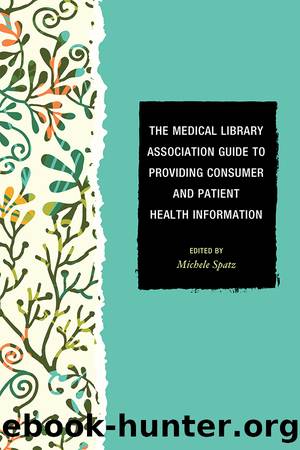
Author:Michele Spatz [Spatz, Michele]
Language: eng
Format: epub
Publisher: Rowman & Littlefield Publishers
Published: 2014-01-15T00:00:00+00:00
Bright Lights: Sharp Memorial Hospital in San Diego, California (Davis, 2011), and Englewood Hospital & Medical Center in Englewood, New Jersey (Lindner and Sabagh, 2004), have both implemented programs in which library staff and volunteers provide reference service at the bedside. A similar program has been started at Stanford Hospital & Clinics that will also include outpatients at the Stanford Cancer Institute (Kumagai, 2013).
Providing a mobile reference service is in many ways the same as any other form of reference. The primary difference is that it is a âcold call.â Patrons did not decide to make contact with a library themselves and they are not expecting to see a librarian. That means that it is important to describe the library services available to them, perhaps even show some samples of the types of printed or other information they would receive. It is also crucial, in any kind of patient care setting, to carefully observe privacy regulations, especially to ask permission and question cautiously when others are present in the room.
Mobile reference provides an opportunity for librarians to further develop relationships with clinical staff. First of all, it is important for clinical staff to support the mobile library concept. Obtaining their âbuy inâ before launching a program is critical. Staff can provide patient lists and suggest patients or family members that they think would appreciate contact from the library.
In serving hospital inpatients, turnaround time is important. Patients may be discharged before the information they requested gets back to them. It is a good idea to respond as quickly as possible and include an invitation to contact the library for more information if desired. Obtaining name and address during the reference interview is a good idea so that the information can be mailed to the patientâs home in the event they are discharged prior to receiving library resources.
Confidentiality, Privacy, and Scope of Service
All ethical librarians practice the principle of patron confidentiality, but never is it more important than in the interactions regarding personal medical research. At medical and consumer health libraries, a patronâs confidence in librarian discretion is paramount. Health librarians often hear many intimate details of someoneâs health history.
When consumer health librarians do their job right, they listen carefully and non-judgmentally, asking questions to ascertain the appropriate information as well as to keep the patron focused. In responding to patronsâ requests, librarians need to be ever mindful of not giving medical advice or opinion, and must sometimes remind patrons of the nature of their role as information liaison, not medical practitioner. In order to avoid misunderstandings about the libraryâs services, itâs important to delineate its service parameters. This may include clearly indicating:
Who can use the service? Is it open to the public or restricted to patients, family members, and those affiliated with the institution?
What types of questions will the library answer?
Are the services free?
What is the typical response time?
What is the privacy policy?
Download
This site does not store any files on its server. We only index and link to content provided by other sites. Please contact the content providers to delete copyright contents if any and email us, we'll remove relevant links or contents immediately.
| Anthropology | Archaeology |
| Philosophy | Politics & Government |
| Social Sciences | Sociology |
| Women's Studies |
Cecilia; Or, Memoirs of an Heiress — Volume 1 by Fanny Burney(32527)
Cecilia; Or, Memoirs of an Heiress — Volume 2 by Fanny Burney(31928)
Cecilia; Or, Memoirs of an Heiress — Volume 3 by Fanny Burney(31916)
The Great Music City by Andrea Baker(31902)
We're Going to Need More Wine by Gabrielle Union(19020)
All the Missing Girls by Megan Miranda(15892)
Pimp by Iceberg Slim(14464)
Bombshells: Glamour Girls of a Lifetime by Sullivan Steve(14039)
For the Love of Europe by Rick Steves(13823)
Talking to Strangers by Malcolm Gladwell(13332)
Norse Mythology by Gaiman Neil(13317)
Fifty Shades Freed by E L James(13216)
Mindhunter: Inside the FBI's Elite Serial Crime Unit by John E. Douglas & Mark Olshaker(9298)
Crazy Rich Asians by Kevin Kwan(9262)
The Lost Art of Listening by Michael P. Nichols(7480)
Enlightenment Now: The Case for Reason, Science, Humanism, and Progress by Steven Pinker(7288)
The Four Agreements by Don Miguel Ruiz(6729)
Bad Blood by John Carreyrou(6601)
Weapons of Math Destruction by Cathy O'Neil(6249)
